The World of Voice AI: How Conversations Are Becoming the New Interface
Voice AI is transforming human-computer interaction through real-time conversations. From smart assistants to AI customer support, businesses are adopting voice technology to automate tasks, improve user experience, and create faster, more natural digital interactions.
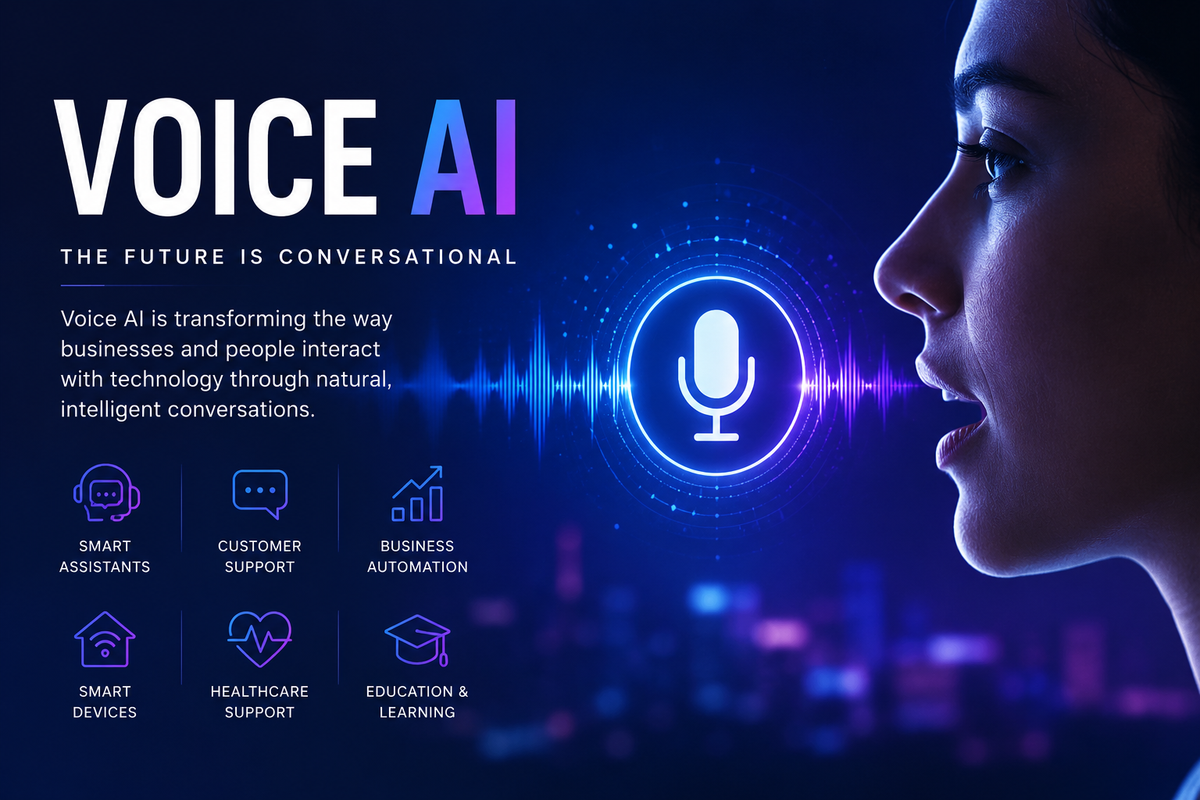
The World of Voice AI
Technology has evolved rapidly over the past decade, but one of the most revolutionary shifts happening today is the rise of Voice AI. Instead of typing commands, clicking buttons, or navigating complicated interfaces, users can now simply speak naturally and receive intelligent responses in real time.
Voice AI is no longer limited to smart assistants like Google Assistant, Apple Siri, or Amazon Alexa. It has expanded into customer support, healthcare, finance, education, sales, automation, and even software development. Businesses across the world are investing heavily in conversational AI systems because voice interaction is becoming faster, more natural, and more human-centered than traditional interfaces.
What is Voice AI?
Voice AI refers to artificial intelligence systems that can understand, process, and respond to human speech. These systems combine several advanced technologies, including:
- Speech Recognition
- Natural Language Processing (NLP)
- Machine Learning
- Text-to-Speech Synthesis
- Conversational Intelligence
Together, these technologies allow machines to understand spoken language, analyze intent, and generate meaningful responses almost instantly.
Modern Voice AI systems can handle natural conversations, detect emotions, support multiple languages, and even maintain contextual memory during interactions.
Why Voice AI is Growing So Fast
The demand for Voice AI has increased because users now expect faster and more convenient interactions. Typing takes time. Navigating complex applications creates friction. Voice removes these barriers.
Several factors are driving this growth:
1. Natural Human Interaction
Humans communicate primarily through speech. Voice interfaces feel intuitive because they align with how people naturally interact.
2. Faster Customer Support
Businesses are using AI voice agents to automate support calls, answer FAQs, schedule appointments, and handle customer queries 24/7 without long waiting times.
3. Smart Automation
Voice AI can integrate with CRMs, databases, APIs, and automation systems to perform actions instantly through spoken commands.
4. Accessibility
Voice technology makes digital products more accessible for users with disabilities or those who struggle with traditional interfaces.
5. Real-Time Intelligence
Modern AI models can now process conversations in real time, enabling highly responsive and human-like interactions.
Real-World Applications of Voice AI
Voice AI is being adopted across almost every industry.
Customer Support
Companies are replacing traditional IVR systems with conversational AI agents that understand natural speech and solve customer problems more efficiently.
Healthcare
Doctors and hospitals use Voice AI for appointment booking, patient assistance, medical transcription, and virtual healthcare assistants.
Education
AI tutors and voice-powered learning platforms help students learn interactively through conversation.
Sales & Lead Qualification
Businesses use AI voice agents to qualify leads, follow up with customers, and automate outbound calling workflows.
Smart Devices
Voice-powered assistants control smart homes, televisions, cars, and connected IoT devices.
The Technology Behind Voice AI
Modern Voice AI systems rely on powerful AI infrastructure and large language models. A typical voice AI pipeline includes:
- Speech-to-Text conversion
- Intent understanding using NLP
- AI reasoning and response generation
- Text-to-Speech voice synthesis
- Real-time conversation orchestration
With advancements in AI models and low-latency streaming technologies, conversations now feel more fluid and human than ever before.
Platforms like OpenAI, Google, and Meta are pushing the boundaries of conversational intelligence, enabling developers to build highly sophisticated voice applications.
Challenges in Voice AI
Despite its rapid growth, Voice AI still faces several challenges:
- Understanding accents and dialects accurately
- Managing noisy environments
- Handling complex contextual conversations
- Ensuring privacy and data security
- Reducing hallucinations and incorrect responses
As models improve, these limitations are gradually being reduced through better training data, contextual reasoning, and multimodal AI systems.
The Future of Voice AI
The future of Voice AI goes far beyond simple assistants. Soon, AI voice agents will become digital coworkers, personal assistants, customer representatives, and intelligent companions capable of handling complex workflows autonomously.
We are moving toward a world where conversations become the primary way humans interact with technology. Applications, websites, and software platforms may eventually rely more on voice interaction than traditional interfaces.
Businesses adopting Voice AI today are positioning themselves at the forefront of the next major technological transformation.
Final Thoughts
Voice AI is not just another trend in artificial intelligence — it represents a fundamental shift in human-computer interaction. As AI models continue to become more intelligent, conversational, and context-aware, voice interfaces will become deeply integrated into our daily lives.
The companies and developers building in this space today are shaping the future of communication, automation, and digital experiences.
The world of Voice AI has only just begun.